A fresh look at yourself
See how you approach different types of logic problems.

Loading questions and setting up your session…
 EN
ENFamiliar shapes. Unexpected patterns.
Try looking at the familiar in a new way.

See how you approach different types of logic problems.

Try tasks involving patterns, numbers, comparison and spatial transformations.

See how you did as soon as you finish.

Focus on the tasks. There is no time limit.

Online, with no registration or countdown.

Your basic result is free when you finish.

About thinking, logic and yourself — in our blog.
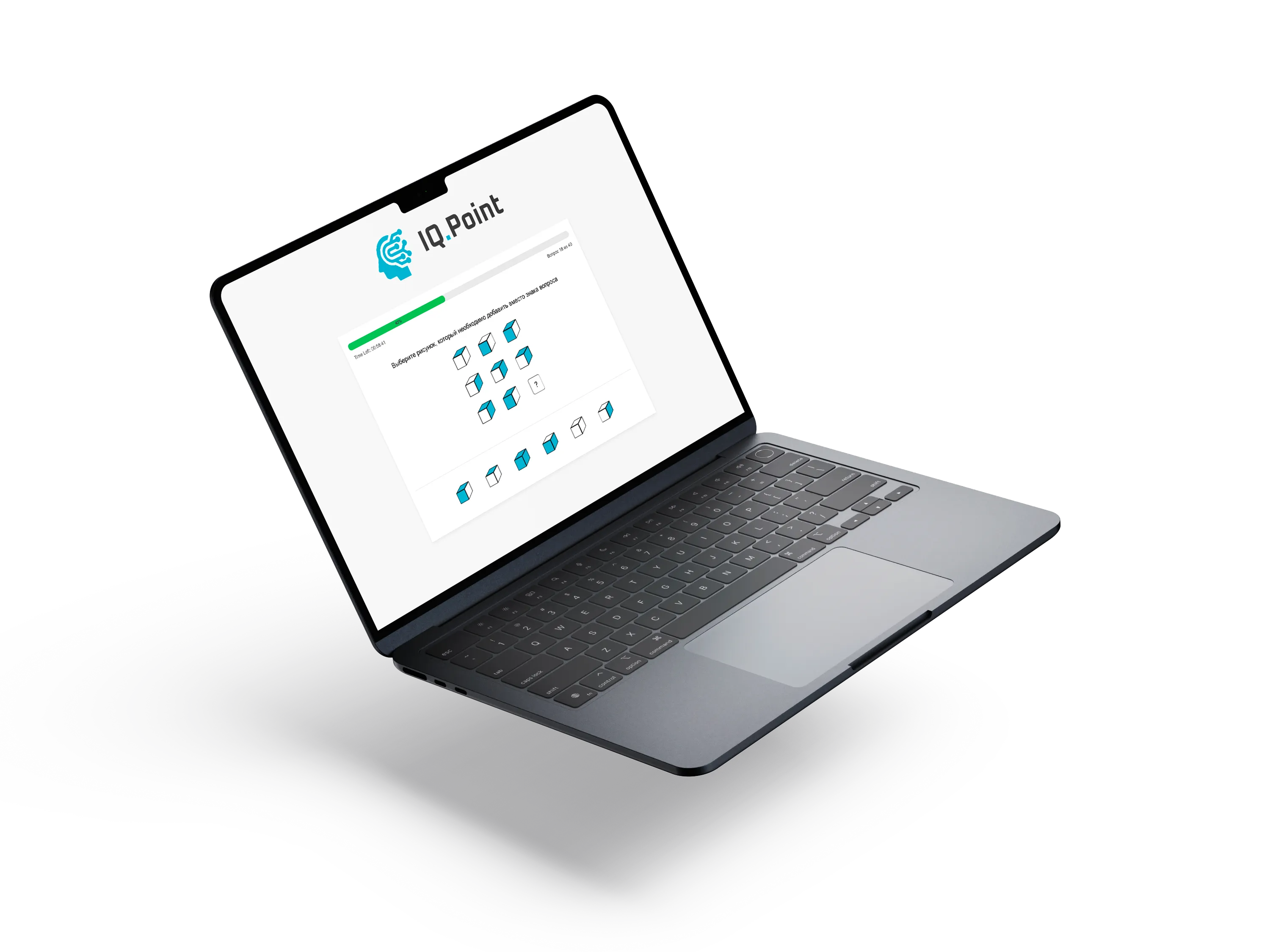

Different types of tasks: visual patterns, numbers and spatial reasoning.
A clear process: choose an option, confirm your answer and continue.
Your preliminary result is free, with no registration required.
Tasks involving patterns, numbers and spatial reasoning.
Sometimes all it takes is looking at something familiar from a different angle.
Compare shapes, positions and numbers of elements, notice changes, and determine which figure should come next.
Look for connections in sequences and relationships between numbers. Sometimes the rule is immediately clear; other times, you need to test several possibilities.
Find the shared principle, identify the odd element out, or choose the option that best fits the conditions of the problem.
Take your time rather than guessing. Examine the details, find the rule, and only then choose your answer.
Take the free test nowOn logic, thinking and little discoveries.
AI can solve problems for us—or help us learn. Why the way we use artificial intelligence matters more than the tool itself.
Read articleA little preparation, a comfortable screen and careful attention to detail can help you approach the test without rushing to guess.
Read articleExcerptShape, position and quantity: learn how to identify changing features, test possible rules and choose the answer that fits every example.
Read articleTake your time: there is no countdown or time limit. At the end, you will see how long you took.
Your result describes how you did on this test's tasks. It does not replace a professional assessment or describe all of a person's abilities.
No registration is needed for the basic test.
The current test version and detailed PDF report are available free of charge.
Yes. Familiar tasks are easier to solve, though: a repeat result may reflect that you remember the questions and solutions.
Number sequences, visual patterns, spatial tasks and finding the odd figure out. See the methodology page for details.
No. In the current version, time is recorded and shown for context, but it does not affect the preliminary IQ estimate. Breaks may also be included in the total completion time.
IQ Lens currently uses a pilot internal scale. The test has not yet undergone full population norming, so the result should be viewed as an estimate within the current version of the test.